Yes, you can have seasonal depression in Southern California, because daylight still shortens every late fall and winter here, and the clock change in November shifts when that light arrives. If you feel low from about November through March and lift in spring, a licensed clinician can tell you whether it fits a seasonal pattern.
If you or someone you love is thinking about suicide or self-harm, call or text 988 any time, day or night. You can also chat with a trained crisis counselor at 988lifeline.org.
Seasonal Depression in Southern California Is Real, and It Has a Name
Clinicians call it seasonal affective disorder, or SAD, and the National Institute of Mental Health describes it as a type of depression that comes and goes with the seasons. For most people with SAD, symptoms start in late fall or early winter and ease in spring and summer. A smaller group has the reverse pattern, with depression arriving in spring or summer.
The pattern is what separates SAD from other depression. The low mood returns at about the same time each year, and it lifts again when the season turns. If November through March feels heavier than the rest of the calendar, and you've noticed it more than once, that repeating timeline is worth writing down.
NIMH lists the signs of SAD as the same ones that appear in major depression, with some that are more common in winter. They include feeling down most of the day, losing interest in things you usually enjoy, low energy, sleeping more than usual, craving carbohydrates with weight gain, trouble concentrating, and feeling hopeless or worthless.
Having a few of these doesn't mean you have SAD, and only a licensed clinician can make that diagnosis. What helps most is a record of what you notice. Jot down the month your mood dipped each of the last two or three years, the month it improved, and how your sleep and appetite changed in between. A clinician will ask about exactly this, since the diagnosis rests on the pattern across years.
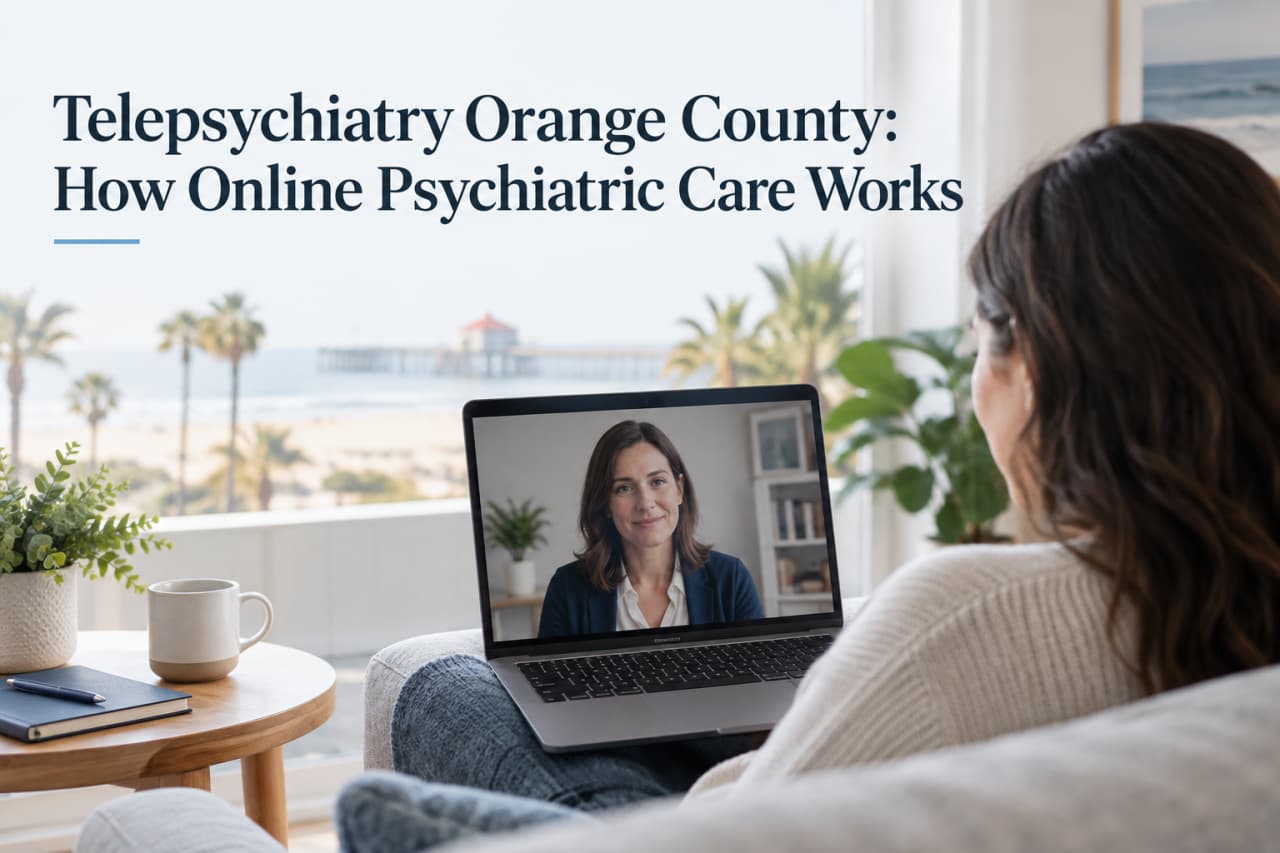
Living in Orange County doesn't exempt you, and you don't need to be in crisis or have a formal diagnosis before you ask for care. At Huntington Beach Mental Health, an appointment happens by secure video from wherever you are in Orange County, so you can talk it through from home.
How Shorter Days and the Clock Change Reach Orange County
Orange County still loses daylight every fall, and your body clock responds to the hours of light, not to how sunny the forecast looks. By late December, days in Southern California are noticeably shorter than in summer, so sunrise comes later and dusk arrives in the late afternoon. Mild weather doesn't change that schedule.
The November clock change adds a second jolt. When daylight saving time ends, the clock moves back an hour, and the sun sets earlier by the clock. Many people leave work in the dark almost immediately. If your mood started slipping within a few weeks of that change, the timing isn't a coincidence you need to explain away.
NIMH notes that SAD is thought to involve changes in the body's internal clock, along with brain chemicals that affect mood, and that reduced daylight may play into both. Researchers haven't pinned down one cause, so it's more accurate to say shorter days are a recognized trigger than to say they explain every case.
Some details of Orange County life can hide the pattern. Marine layer mornings keep many coastal days gray into the afternoon. A job spent indoors can mean you see very little daylight even when it's bright outside. And friends who say "it's 70 degrees, how could you be down?" make it easy to dismiss what you feel.
To check your own timeline, look at the week of the clock change in your calendar or phone notes for the past few years. Then see whether your sleep, energy, or interest in things shifted in the weeks after it. A clinician can use that record, and so can you when you describe it out loud.
Sleep is often the first thing to move, so the routine you keep around bedtime and wake time matters. Our sleep hygiene and routine service looks at those habits directly, and a clinician may discuss it with you alongside therapy.
Telling Seasonal Patterns Apart From Winter Blues and Ongoing Depression
Winter blues are milder and don't get in the way of daily life, while seasonal affective disorder and ongoing depression both do, and the main difference between those two is timing. The National Institute of Mental Health notes that SAD follows a seasonal pattern, with symptoms that start and end around the same time each year. Ongoing depression doesn't track the calendar that way.
Winter blues usually mean you're a little slower and a little less social, and you still get through work, school, and relationships. If you're missing deadlines, pulling away from people you care about, or can't enjoy anything for weeks at a stretch, that's beyond a rough season and worth bringing to a clinician.
Ongoing depression can start in any month and doesn't reliably lift when spring arrives. It's also possible to have both, such as depression that's present all year and gets worse in winter. You can't sort that out by yourself. NIMH also says some people with bipolar disorder have mood episodes that vary with the seasons, which is one reason a proper assessment matters before anyone assumes the cause.
A good assessment starts with when your symptoms began, how many winters you've had them, and what your mood is like in summer. The clinician will ask about sleep, appetite, and energy, and may use a short questionnaire like the PHQ-9 to see how severe things are. Your notes from past winters make those answers much more precise.
If your mood hasn't lifted by late spring, or you've felt low through a summer, say so plainly. That detail changes the conversation. You can also see how we approach depression treatment, which is delivered by secure video from wherever you are in Orange County.
Treatments Clinicians Use for Seasonal Depression
Treatment for seasonal depression usually starts with talk therapy, and the National Institute of Mental Health lists four main options: psychotherapy, antidepressant medication, light therapy, and vitamin D. It also notes that vitamin D hasn't been shown to work as well as the others, so it's a question for your clinician rather than a shelf purchase. The right mix depends on how severe your symptoms are and what you've tried before.
Cognitive behavioral therapy is the approach NIMH describes for SAD, and it's one we offer by video. In CBT you learn to spot the thoughts that deepen a low mood and replace them with more accurate ones. You also practice behavioral activation, which means scheduling activities you'd normally enjoy even when you don't feel like doing them. Between sessions, you try those exercises in your own week, and your clinician adjusts the plan as you report back.
Medication is a separate decision made with a prescriber. If your symptoms are severe, a psychiatric assessment can show whether medication belongs in your plan, and medication management keeps that conversation going over time. Please don't start, stop, or change any medication on your own.
NIMH also cites light therapy, which uses a special light box for a set time each day, usually in the morning. Talk with a clinician before you try it, since the type of device and how you use it matter, and it isn't right for everyone.
At the first appointment with us, you describe your symptoms and your past winters using the notes you've kept. A clinician asks about sleep, appetite, energy, and mood across the year. Then you and the clinician write a treatment plan together, and it's reviewed as care goes on.
Starting care before winter deepens, such as in October or around the clock change, gives you more time to build skills. You don't have to wait for a bad month, though, and starting in the middle of one is still worthwhile.
When to Talk to a Clinician and What Happens Next
Reach out as soon as low mood has returned for a second or third winter, or sooner if it's already interfering with work, school, sleep, or your relationships. You don't need to wait for a bad month, a crisis, or a formal diagnosis. A licensed clinician makes any diagnosis, and your notes from past winters give that conversation a head start.
If someone is in immediate danger, call 911. Our crisis intervention is delivered by video and isn't an emergency service, so use emergency lines first.
Once you decide to reach out, the first step is requesting an appointment on our Contact page. Your sessions happen by secure video, so you can join from home anywhere in Orange County. There's no office to travel to and no in-person visit.
Insurance is worth sorting out early. We work with most major insurance plans, though benefits vary by plan, so check your coverage on our Insurance Verification page before your first session.
If your symptoms are more than a winter dip, your clinician may suggest more than weekly therapy. Our virtual intensive outpatient program and virtual partial hospitalization program are also delivered by video, and a clinician can talk with you about whether either fits. Therapy can also be combined with a psychiatric assessment when that's appropriate.
Bring your month-by-month notes, a list of anything you've already tried, and your questions. If November has already started to feel heavy, request an appointment today.
Selected references
National Institute of Mental Health, Seasonal Affective Disorder